Coccidiosis is a disease caused by Eimeria, a protozoan parasite that plays a major role in poultry health. It has a significant impact on the performance and productivity of both broiler and layer chickens.
Taxonomically, Eimeria belongs to the phylum Apicomplexa, class Sporozoasida, subclass Coccidiasina, order Eucoccidiorida, suborder Eimeriorina, family Eimeriidae, and genus Eimeria.
In a public lecture, Umi Cahyaningsih, a lecturer at the Division of Parasitology and Health Entomology, School of Veterinary Medicine and Biomedicine (SKHB), IPB University, explained that the defining feature of Apicomplexa is its unique apical complex. This structure includes components such as the polar ring, conoid, microtubules, micronemes, rhoptries, and micropores, all of which are essential for host cell invasion.
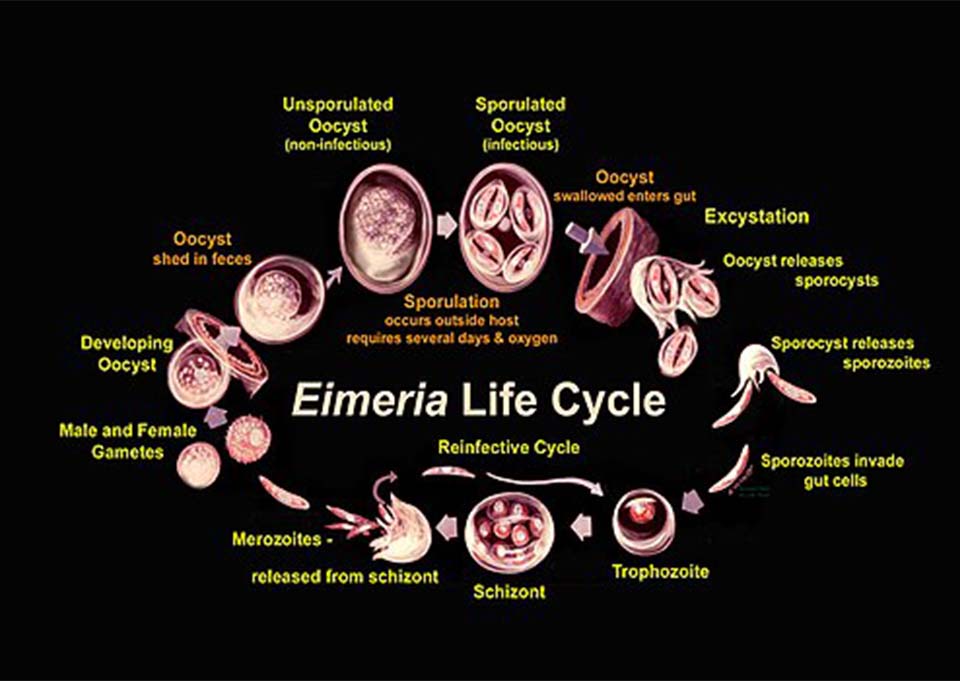
According to Umi, the oocyst is one of the most critical structures to examine. It has a solid wall and contains four sporocysts, each with two sporozoites, totaling eight sporozoites per oocyst. These sporozoites are infective and capable of initiating infection once the oocyst wall ruptures. However, oocysts shed through chicken feces in a non-sporulated state are not yet infectious.
“Eimeria identification is done by observing oocyst morphology—including shape, size, internal organelles, the time of sporulation, and the prepatent period. Each species has a different sporulation time, which helps determine the species of Eimeria,” she explained. “In addition, the parasite’s location in the intestine and molecular diagnostic methods such as Polymerase Chain Reaction (PCR) and DNA (Deoxyribonucleic Acid) sequencing are also used for accurate identification.”
She further explained that chickens are affected by nine species of Eimeria, each targeting a different section of the digestive tract:
In the cecum: E. tenella and E. necatrix — two highly pathogenic species that commonly cause bloody diarrhea.
In the upper small intestine: E. acervulina, E. praecox, E. hagani, and E. mivati.
In the middle small intestine: E. maxima and E. necatrix.
In the lower small intestine: E. mitis and E. brunetti.
Umi noted that different Eimeria species can be identified based on the shape of their oocysts, which can be ovoid, ellipsoid, or subspherical, as well as by calculating the length-to-width ratio. Both morphology and intestinal location influence the pathogenicity and economic impact of each species.
“For example,” she said, “E. acervulina and E. maxima may not cause bloody diarrhea, but they still lead to significant production losses by interfering with nutrient absorption, which hampers growth and feed efficiency.”